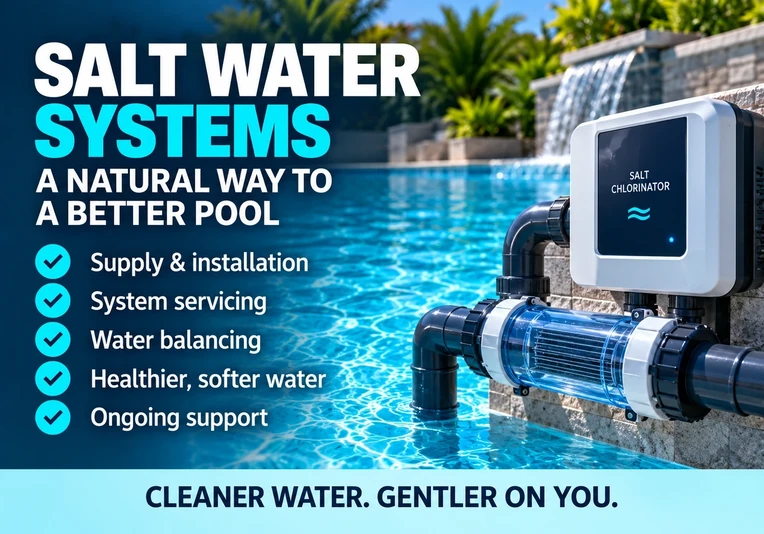
Salt water and traditional chlorine pools are often described as completely different systems. In reality, they have more in common than most owners expect. A salt chlorinator uses dissolved salt to generate chlorine, while a traditional pool receives chlorine directly through products or dosing equipment. Either system can produce excellent water when circulation, filtration and chemistry are managed correctly.
The better choice depends on the existing pool, how it is used, the equipment condition and how much day-to-day dosing you want to manage. Pool Crew installs and services salt water pool systems, while our broader pool servicing covers circulation, equipment and water-care checks around either system.
What a salt chlorinator actually does
The chlorinator cell converts chloride ions in the salty water into chlorine as water passes through the equipment. That chlorine sanitises the pool and then continues through the normal chemical cycle. It is therefore incorrect to market salt pools as “chlorine-free”. They are a different way of supplying chlorine.
This distinction matters because the same fundamentals still apply. The CDC guidance on residential pool testing explains why disinfectant and pH should be checked regularly. A salt cell cannot compensate for poor filtration, poor circulation or badly unbalanced water.
Where salt water feels different
Many swimmers describe a well-managed salt pool as softer-feeling because the sanitiser is generated steadily rather than added in larger manual doses. That can make day-to-day management more convenient, particularly for pools used frequently.
Convenience is not the same as “maintenance free”. Cells need inspection and eventually replacement. Salt concentration must remain within the chlorinator manufacturer’s range. pH can still drift. The pump and filter still need to move and clean the water.
Traditional chlorine can be simple and effective
A conventional chlorine pool can be straightforward to run when the owner has a consistent testing routine and understands the products being used. It can also be easier to troubleshoot when an existing pool already has simple, reliable equipment.
Brands such as hth and Africhem publish product information for sanitising, balancing and corrective treatments. On our own site, see how Pool Crew uses hth products and our Africhem guide.
Salt water equipment still needs the right circulation
A chlorinator only treats water while the circulation system is operating. If a pump is undersized, losing prime, leaking or operating against a blocked filter, the chlorinator may not get enough flow. That is why a salt conversion should include an assessment of the existing pump, filter, pipework and electrical installation.
See pool pump installation and repairs for circulation problems and pool filter installation and repairs for filter sizing, media, valves and pressure concerns.
What about corrosion?
Salt itself does not automatically ruin a pool, but incorrect water chemistry, leaks, poor bonding/earthing practices, unsuitable materials and unmanaged salt spray can all shorten equipment life. In a coastal environment, exposed hardware already deserves routine inspection, so a salt system should be installed as part of a properly considered equipment setup rather than simply added to the return line.
If you are renovating at the same time, it can be sensible to plan the chlorinator, pump, filter, lighting and surface finish together. Our pool renovation service and renovation planning guide cover that broader approach.
Which system is cheaper?
There is no honest one-line answer. Salt systems have an upfront chlorinator cost and a cell that will eventually need replacement. Traditional chlorine has an ongoing product cost and usually needs more manual dosing. Electricity usage depends more on pump runtime, flow requirements and pump technology than on the sanitising method alone.
If energy use is part of the decision, the ENERGY STAR pool pump guidance explains why variable-speed pumps can match different flow requirements more efficiently than running a single-speed pump at one high speed.
Who should consider salt conversion?
- Owners who want more automated day-to-day chlorine generation.
- Pools that already have sound circulation and filtration equipment.
- Homes where the owner is comfortable monitoring salt level and pH.
- Renovations where the chlorination system can be planned with the rest of the equipment.
A conversion may be less attractive where the existing equipment is already failing, the plumbing needs repair, or the pool owner assumes salt means no testing or maintenance. In those cases, fixing the basic system first is usually the better investment.
Before choosing, inspect the pool you already have
We would rather recommend the system that suits the pool than sell a conversion by default. Start with the condition of the pump, filter, surface, plumbing and electrical supply. If you want us to look at the setup, use Pool Visualiser to send photos or contact Pool Crew.
Useful external references
Talk to Pool Crew
For weekly, bi-weekly or monthly pool cleaning, a major or once-off clean, green pool recovery, pump or filter work, leak detection or general pool help in Port Elizabeth, speak to our team.